





Severine Henriette Meier & Jonas Mosbacher
Miracle Pending
05.09 - 10.10.2025
In their figurative paintings, Severine Henriette Meier and Jonas Mosbacher draw on a wide range of art historical sources. Both artists intertwine these references with elements of pop culture. In doing so, they examine how painting—seemingly an anachronistic medium in the digital age—positions itself at a time when the representation of the human body enters new fields of tension. Their works open up distinct perspectives on themes such as gender, society, irony, and historiography.
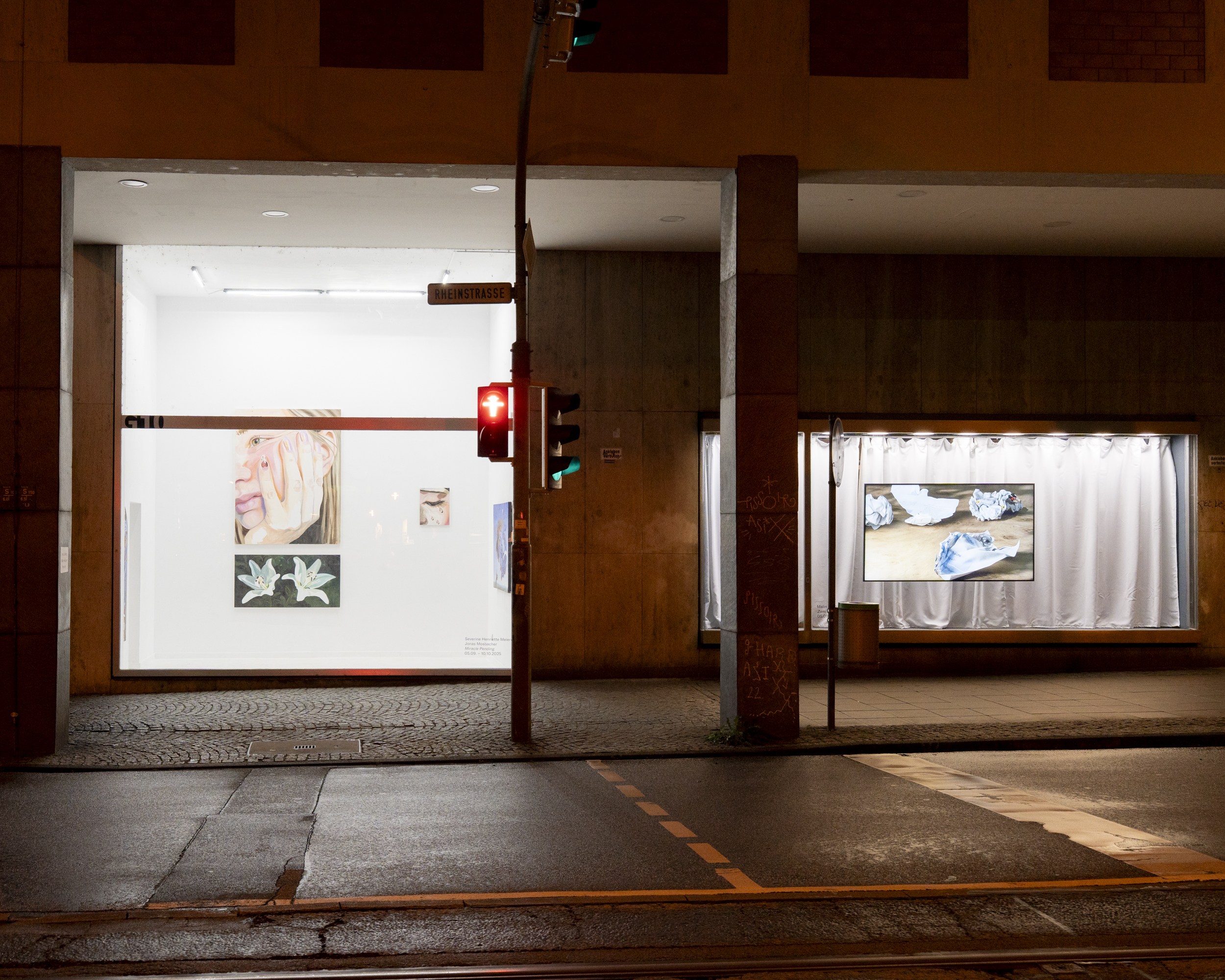
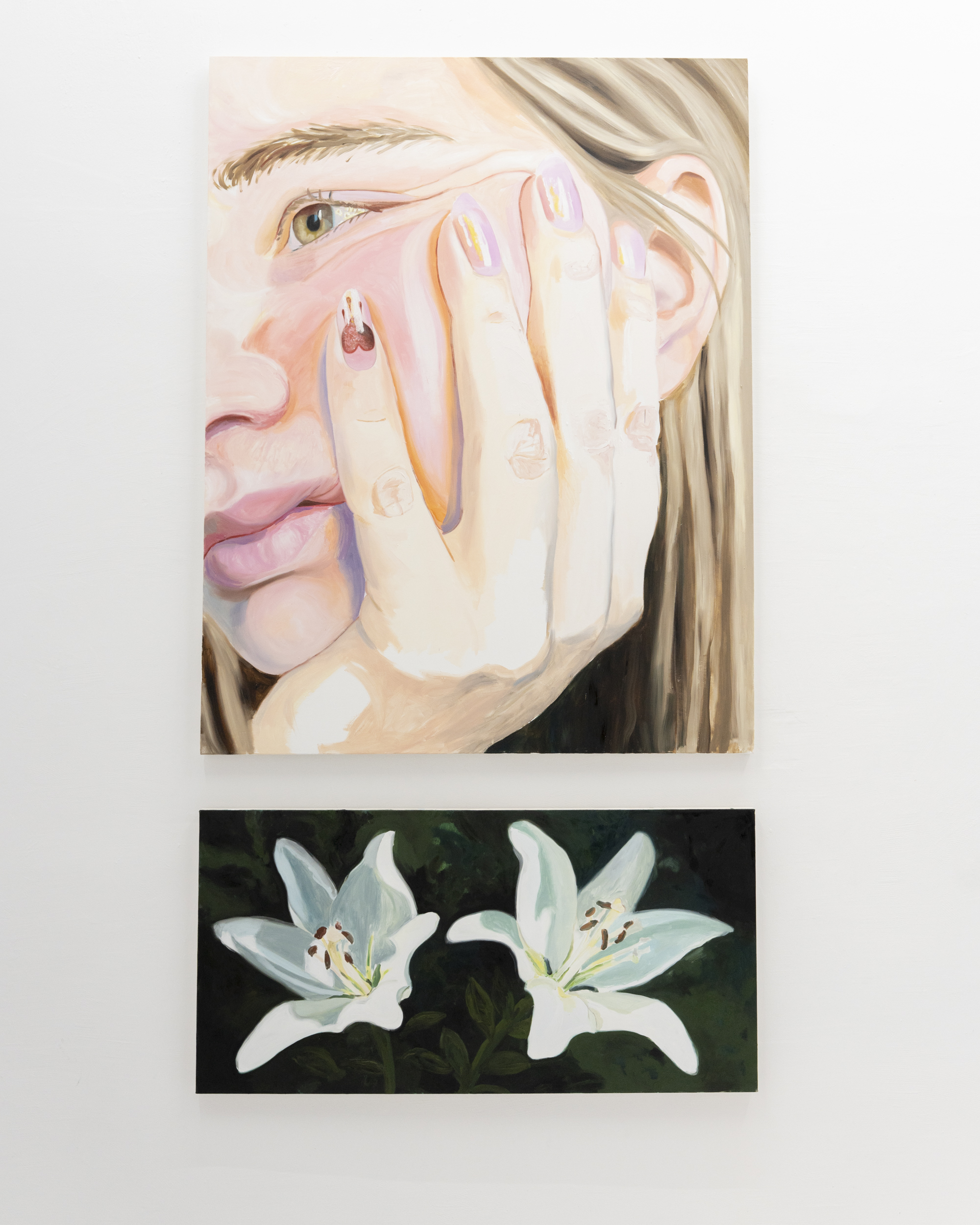
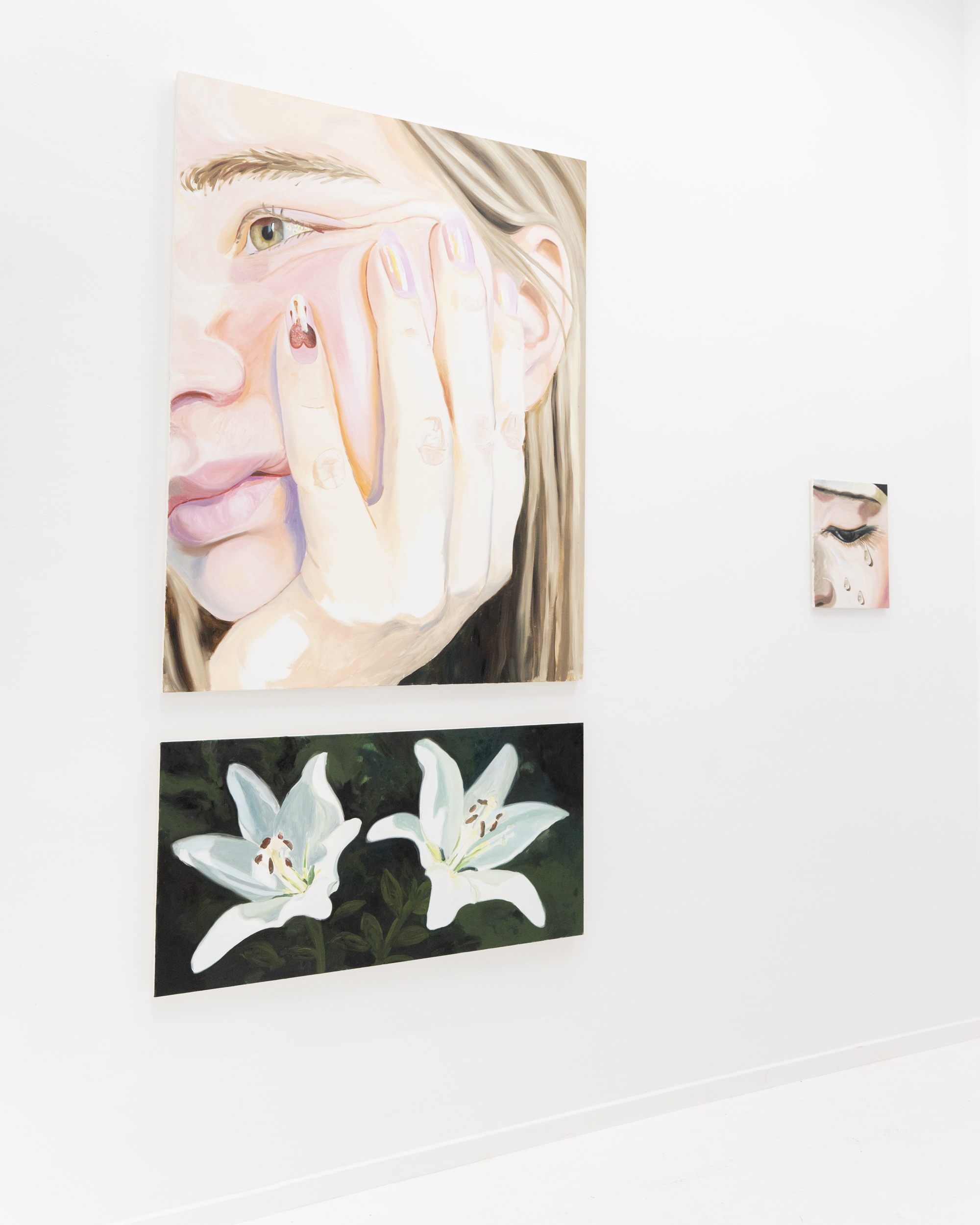
Severine Henriette Meier focuses on the construction of femininity in Western societies, emphasizing feminist perspectives. In her work Beeing Women’d, exhibited at G10, she explores the biblical figure of Mary and the role ascribed to her by Christian tradition. As one of the few prominent female figures in Christianity, Mary was stylized both as an ideal of womanhood and as a moral authority—an idealized virtue that no “worldly” woman could ever attain.
But were not all her virtues imposed on Mary by patriarchal historiography? In Meier’s painting, the figure appears young, contemporary, and turns away skeptically and sadly, her head resting on her hand. Deep lines frame her weary gaze; she seems exhausted by the ideological burden she must carry as a projection surface for purity and virginity. This critique is reinforced by a second painting: two lilies—traditionally symbols of chastity, purity of soul, and innocence—appear not as a promise, but as an additional source of pressure.
Formally as well, Meier translates this critical engagement into her painterly approach. Using oil paint applied in varying degrees of opacity, she creates both translucent skin tones and dense, pastose surfaces. Her technique of alla prima painting—placing color directly without corrections—deliberately resists the tradition of layered painting. This method leaves the surface open, allowing corporeality to break through. In an intensive process, Meier devotes herself to the depiction of individual parts of the body, marked by great tenderness and intimacy.
Jonas Mosbacher operates at the intersection of the sacred and the everyday, combining biblical motifs with ironic distortions. He draws on the compositions and techniques of the so-called Old Masters, whose religious subjects are highly connoted but often appear generic and interchangeable to viewers, especially in the abundance in which they are displayed in Western classical museums.
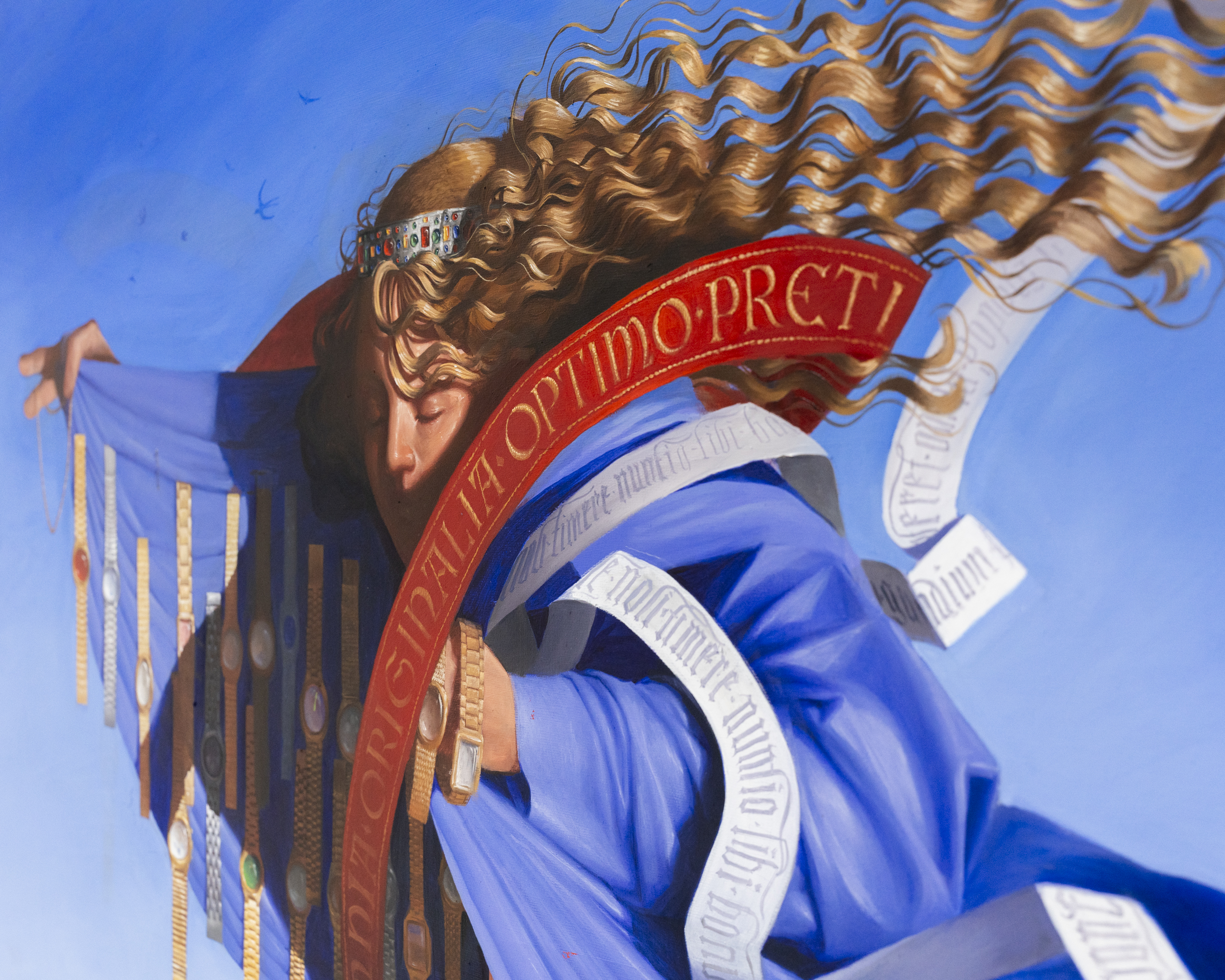
At first glance, his painting Noli Timere resembles a 16th-century Dutch Annunciation scene: An angel wrapped in a blue cloak flies before a cloudless sky, a scroll with the glad tidings flutters in the wind, and on the horizon a medieval town emerges in the bluish haze. Yet instead of Mary, the angel encounters a man, to whom he offers gleaming watches from his opened cloak. The divine message of Christ’s conception is replaced by a commercial display of goods.
Here, Mosbacher deliberately plays with our cultural memory. While the mind initially locates the work within a Western museum context, details soon disrupt this expectation: the watches spilling from the angel’s cloak recall 1980s film scenes, in which shady figures in trench coats peddle their goods on the black market. This familiar cinematic cliché merges with religious imagery: in Mosbacher’s painting, the sales pitch descends directly from heaven, framed as a divine revelation. The inscription on the banner reads: omnia originalia optimo pretio (“all originals at the best price”). Salvation itself is here transformed into a capitalist promise.
In Miracle Pending, Severine Henriette Meier and Jonas Mosbacher approach religious meaning, heritage, and iconography from a contemporary perspective that oscillates between gravity and irony. Their paintings strip traditional imagery of its self-evidence and open it to pressing contemporary questions—of gender, power, consumption, and belief. The sacred is neither dismissed nor revered, but revealed as a living field of projection.
Severine Henriette Meier (*1993 in St Priest en Jarez, France) graduated in Fine Art from Offenbach University of Art and Design in 2022. Prior to this, she studied Fine Art and Textile Design at the Academy of Fine Arts in Ghent. Her work has been featured in several exhibitions, including at the Monica Ruppert Gallery in Frankfurt (2025), Basis Frankfurt (2024 & 2022), the 1822 Forum Frankfurt (2024), the Futur3 Festival in Kiel (2023), the Salon der Gegenwart in Hamburg (2022), Magma Maria in Offenbach (2022 & 2021), the Museum für Angewandte Kunst Frankfurt (2021), and the Opelvillen Rüsselsheim (2020).
Jonas Mosbacher (*1996 in Lörrach) completed his studies in graphic design and fine art at Burg Giebichenstein University of Art and Design in Halle/Saale in 2024. In 2019, he spent a year as a guest student at the Städelschule in Frankfurt. His works have been featured in several exhibitions, including at the Spinnerei Leipzig (2025), the Galerie Laetitia Gorsy in Leipzig (2025, 2024), the Xylon Kunstmuseum Schwetzingen (2025), the Burg Galerie Volkspark in Halle (2025), the Galerie KA32 in Berlin (2024), the Accademia di Belle Arti in Palermo (2023), the McLaughlin Gallery in Berlin (2021) and the 3LandGallery Lörrach (2020).
Malin Dorn
Zwei blaue Haken
05.09 - 10.10.2025
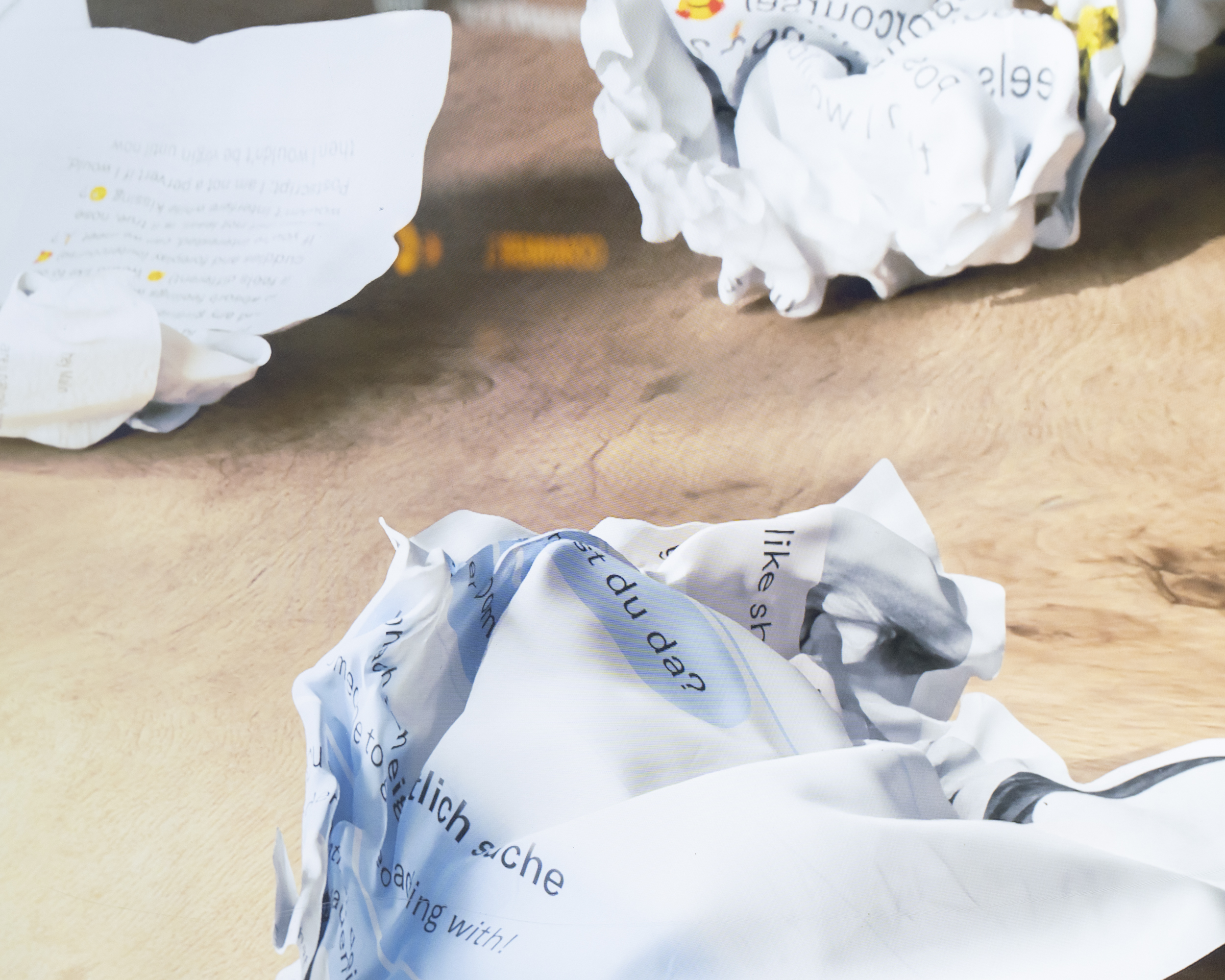
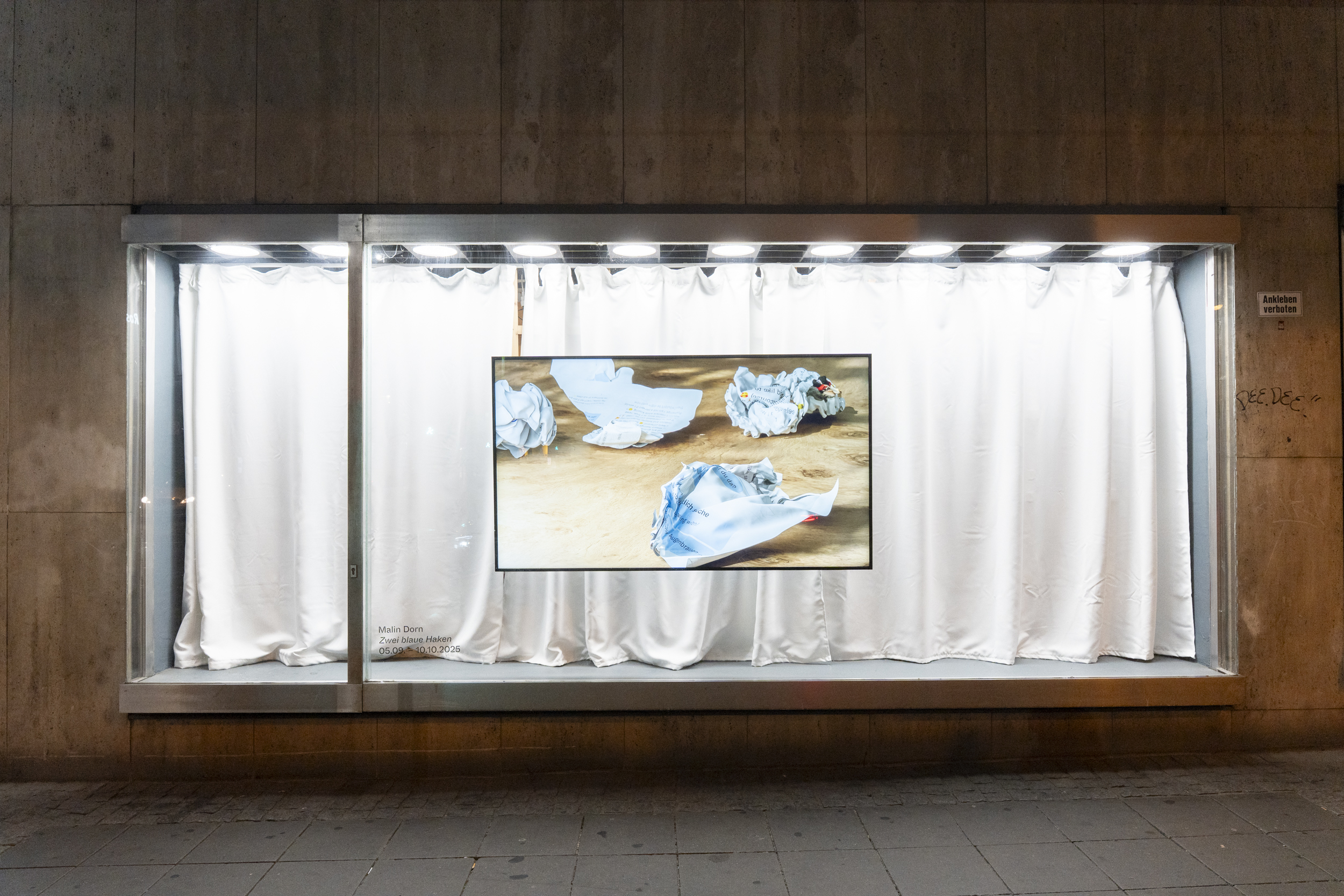
The video work Zwei blaue Haken is part of a broader artistic exploration of the conditions of contemporary communication and the ways in which we seek closeness but also encounter rejection. The 3D animation is based on screenshots of messages from dating apps that Malin Dorn herself received. The only fragmentarily visible interfaces and texts bear witness to contact attempts that were insulting and in part transgressive, and which consequently remained unanswered. On 3D-modeled paper balls, these fragments appear like fleeting notes or discarded letters, archived as relics of failed communication.
The work unfolds in the tension between digital simulation and painterly composition. The objects arranged in the virtual space draw on the tradition of still life: they appear as ephemeral remnants within a carefully balanced pictorial order. At the same time, the artist subverts this order by letting the paper fragments tremble in the wind, roll into the image, or seem to be thrown in at random. The cyclical repetition of the sequence reinforces the impression of an endless recurrence of failed attempts at connection.
Malin Dorn (*1993 in Kiel) completed her Bachelor’s degree with a focus on photography at the Muthesius University of Fine Arts and Design in Kiel in 2018. In 2023, she received her Master’s degree in Time-Based Media at HFBK Hamburg in the class of Simon Denny. Dorn’s works have been presented in various exhibitions, including at Kunstverein Gastgarten in Hamburg (2025), Künstlerhaus Palais Thurn und Taxis in Bregenz (2024), Magma Maria in Offenbach (2023), fffriedrich in Frankfurt (2022), the Goethe-Institut, Paris (2021), and Galerie LaDöns in Hamburg (2021).
Text: Carolina Maddè
Photography: Nils Heck
Photography: Nils Heck